What gear do you need for winter snow camping and cold-weather overlanding?
Staying warm in sub-freezing snow starts from the ground up: pair a high-R-value insulated mattress like the Exped MegaMat Duo 10 (R-value 8.1) with a cold-weather sleeping bag such as the TETON Sports Mammoth 0°F Double Bag. For active tent heating, we run either a Mr. Heater Portable Buddy connected via a 10-foot hose and filter to a 20 lb propane cylinder or a 12V portable diesel air heater—always paired with a battery-powered Kidde Digital Carbon Monoxide Detector.
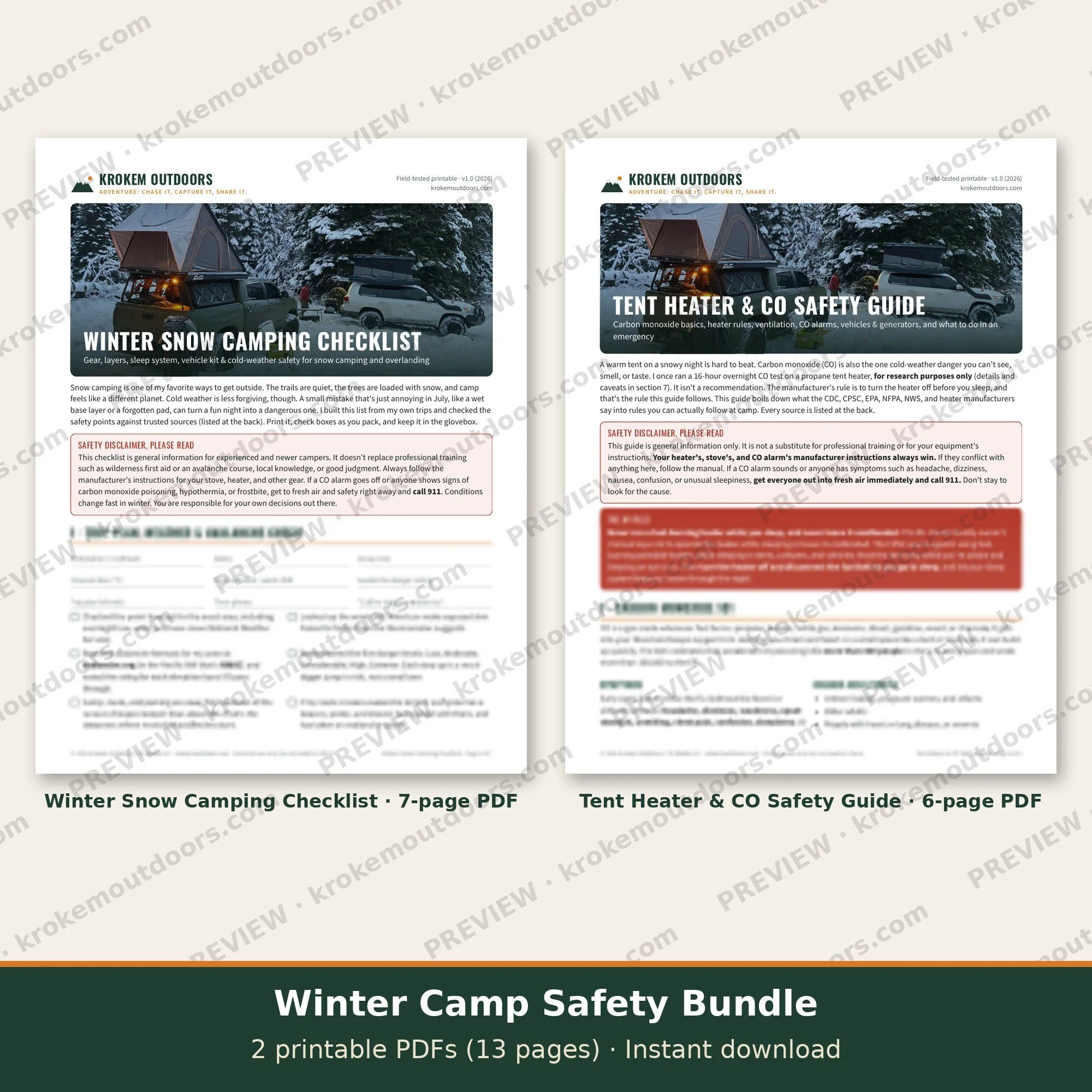
The 7-page Winter Snow Camping Checklist covers layers, sleep system, shelter, vehicle kit and cold injuries. Instant PDF for your phone. $2.99.
Get the winter checklist - $2.99
Is it safe to run a Mr. Heater Buddy propane heater inside a camping tent?
In our 16-hour propane tent heater Carbon Monoxide test (823K+ views), the indoor-safe Mr. Heater Portable Buddy (which includes an automatic low-oxygen ODS shutoff pilot and tip-over switch) maintained 0 PPM carbon monoxide inside a ventilated tent across 16 hours on a 20 lb tank. Even so, never seal a tent airtight: always crack upper and lower mesh vents for cross-ventilation, keep sleeping bags at least 24 inches away from the burner guard, and keep a digital CO alarm at sleeping height.
Toyota Tundra vs. Ram 1500 Rebel vs. Jeep Rubicon EcoDiesel: Which 4x4 overland build is best?
After building all three platforms: our 2019 Toyota Tundra TRD Off-Road (“Shadow”) on an ICON Stage 9 lift and 35" BFGoodrich KO2s (with zero cab-mount chop on 18×9 +25mm SCS Ray 10 wheels) is a bulletproof solo and two-person bed-rack overland truck. Our 2021 Ram 1500 Rebel (“The Family Wagon”) with an Alu-Cab Alu-Cabin standing-room canopy camper is our pick for four-season family expeditions. And our Jeep Wrangler Rubicon 3.0L EcoDiesel on 40" tires (with 5.13 gears, RCV CV shafts, and Rock Krawler 4.5" suspension) dominates deep snow wheeling and tight rock trails.
How much does a 5-day backpacking gear loadout weigh and what should you pack?
A complete four-season-ready 5-day backcountry backpacking loadout weighs 45 to 48 lbs fully loaded with food, fuel, water, and bear canister (or 35 to 40 lbs for a 2-night weekend loop). Core items include a 100L Gregory pack, Snugpak Scorpion 3 tent, stacked Therm-a-Rest Z Lite Sol + Sea to Summit insulated air pad, Sawyer Squeeze water filter, BearVault BV500, and a Silky BigBoy 360mm folding saw.
Clamshell vs. fold-out hard shell rooftop tent vs. Alu-Cab canopy camper: Which should you buy?
In our long-term hard shell rooftop tent review, fold-out hard shells (like the iKamper Skycamp 2.0) give you a king-size sleeping footprint on a short-bed truck rack like the Leitner ACS. Aluminum clamshell rooftop tents win on 60-second setup speed, wind stability, and leaving pillows/sleeping bags inside when closed. If you camp year-round in rain and snow with family, stepping up to a one-piece Alu-Cab Alu-Cabin canopy camper gives you standing room, dry mudroom entry, and instant camp setup without climbing an exterior ladder.
How long does an 8 oz IsoPro camping stove fuel canister actually last?
In our controlled 8 oz (227g) MSR IsoPro fuel canister burn test at full throttle, the heat-exchanger Jetboil Flash ran for 3 hours 35 minutes and boiled 71 two-cup (16 oz) pots of water. By comparison, an ultralight non-heat-exchanger pocket burner (Optimus Crux Lite with a titanium pot) ran for 2 hours 20 minutes and achieved 48 two-cup boils—meaning a heat-exchanger stove gives you ~48% more boils per canister on multi-day trips.